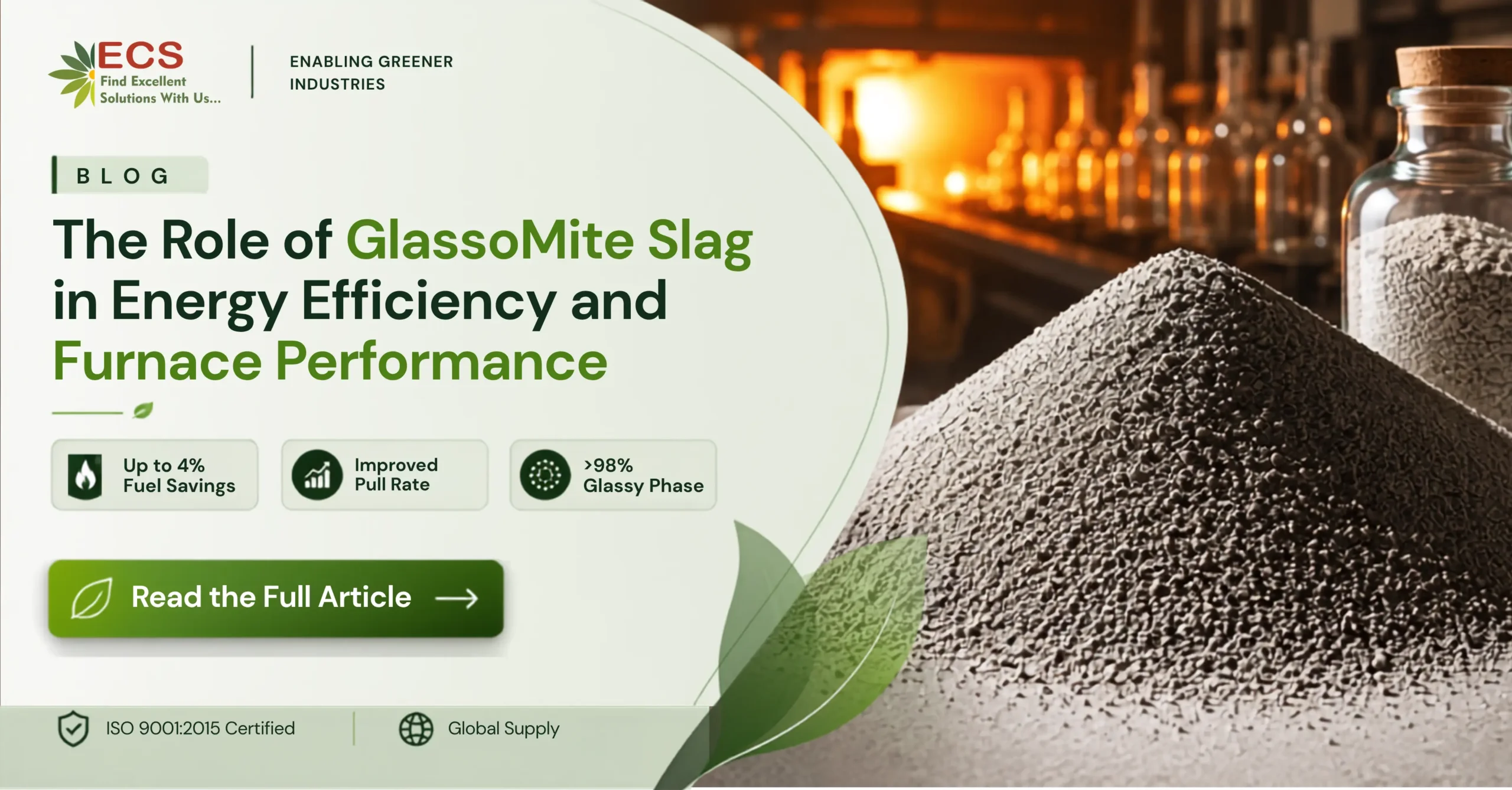
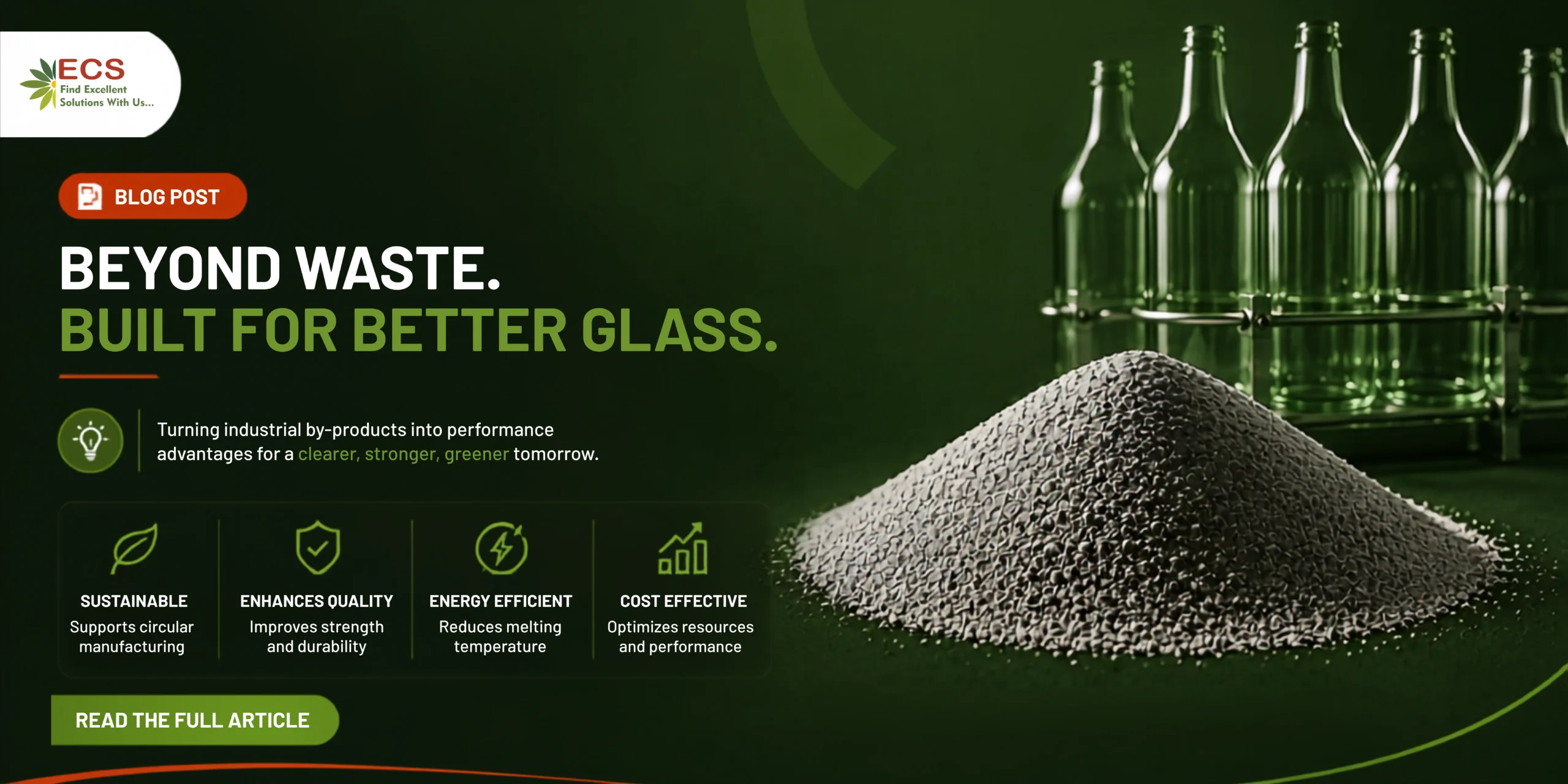
Quick Answer: Glassomite Slag — branded as GlassoMite — is an eco-friendly, alumina-rich mineral made from granulated blast furnace slag (a steel-industry by-product), used as a raw material in soda-lime silica glass production. It cuts furnace energy use by 2.5%–4%, increases furnace pull by up to 10%, and reduces CO₂, SO₂, and NOx emissions, because its pre-reacted, glassy structure melts more efficiently than traditional raw materials like limestone and dolomite. It’s supplied by Eco Clay Solutions.
Glass manufacturers evaluating raw materials to cut energy costs, hit emissions targets, and improve melt quality are increasingly turning to Glassomite Slag. Unlike a generic industrial by-product repurposed as filler, GlassoMite is a purpose-engineered material — refined specifically to behave like pre-reacted glass inside a furnace, which is where nearly all of its performance advantage comes from.
What Is Glassomite Slag? (Entity Definition)
Glassomite Slag is the common name for GlassoMite, a homogenous, alumina-rich mineral solution manufactured by Eco Clay Solutions for use in soda-lime silica glass production. It is derived from granulated blast furnace slag (GBFS), a by-product of steel manufacturing.
- Category: Industrial mineral / glass raw material
- Source material: Granulated blast furnace slag (GBFS), a steel-industry by-product
- Primary use: Raw material input for clear, amber, green container glass, and float glass
- Supplier: Eco Clay Solutions
- Core property: Glassy, pre-reacted structure with controlled redox behaviour
The Chemistry of Glassomite Slag (Typical COA)
| Component | Typical % |
| SiO₂ | 31.92 |
| Al₂O₃ | 19.44 |
| CaO | 10.84 |
| Fe₂O₃ | 0.28 |
| TiO₂ | 0.56 |
| MgO | 0.41 |
| Na₂O | 0.74 |
| K₂O | 0.76 |
| MnO | 0.48 |
| SO₃ | 0.18 |
| Total S | 0.76 |
| Carbon | 0.25 |
Key fact: Glassomite Slag contributes approximately 15%–40% of the CaO required in the final glass composition — directly reducing dependence on limestone and dolomite.
How Glassomite Slag Works: 2 Mechanisms
1. Glassy Nature — Faster Melting at Lower Energy
Because Glassomite Slag is already glassy and pre-reacted (similar to recycled cullet), it participates in batch reactions at lower temperatures. This:
- Supplies glassmaking oxides directly to the melt
- Minimises the energy-intensive endothermic decomposition that normally occurs at 800–900°C
- Accelerates homogenisation once it liquefies at melting temperature
2. Controlled Redox Behaviour — Better Refining & Colour Stability
Trace carbon and sulphide in Glassomite Slag give it mild, controllable reducing properties — unlike aggressive reducing agents, it can be added in higher quantities without destabilising the melt. This:
- Improves redox balance and colour consistency
- Lowers the decomposition temperature of sodium sulphate
- Reduces defects such as seeds and blisters
Measurable Results: Glassomite Slag by the Numbers
| Metric | Result |
| Energy use reduction | 2.5% – 4% |
| Furnace pull increase | Up to 10% |
| Glass conversion rate | 100% (zero waste) |
| CaO contribution to final glass | 15% – 40% |
| Emissions reduced | CO₂, SO₂, NOx, SOx |
| Refractory wear | Reduced, extending furnace campaign life |
Glassomite Slag vs. Traditional Raw Materials
| Factor | Glassomite Slag | Limestone / Dolomite |
| Melting behaviour | Pre-reacted, glassy — melts at lower temperature | Requires energy-intensive decomposition (800–900°C) |
| Energy impact | Cuts energy use 2.5%–4% | Higher energy demand |
| Source | Recycled steel-industry by-product | Virgin mined material |
| Redox contribution | Mild, controllable reducing agent | None |
| Waste | 100% converts into glass | N/A |
Typical Usage Levels by Glass Type
| Glass Type | Typical Dosage (% of dry silica sand weight) |
| Clear Container Glass | 6% – 7% |
| Amber Container Glass | 18% – 22% |
| Green Container Glass | 10% – 13% |
| Float Glass | 3% – 8% |
How Glassomite Slag Is Implemented in a Furnace
- Evaluate glass composition — assess existing batch and colour requirements
- Define optimal dosage — based on glass type and furnace conditions
- Implement in phases — controlled trials with gradual dosage adjustments
- Monitor furnace performance — track real-world response
- Finalise dosage — based on plant trial data, guided by independent glass technologists
“[Insert a short, named quote here from your technical lead or a glass technologist — e.g., ‘“In our trials, phased implementation of GlassoMite let us reach optimal dosage without any disruption to colour stability.” — [Name], [Title], Eco Clay Solutions’]. Attributed quotes from a real, named expert are one of the strongest signals AI systems use to decide what to cite — this section should not stay generic.
Why Glassomite Slag Matters for Sustainability
Converting a steel-industry by-product into a high-performance glass raw material delivers three compounding effects:
- Lower carbon footprint per tonne of glass produced
- Circular economy impact — repurposing existing industrial by-product instead of virgin material
- Long-term compliance with tightening global emissions regulations
Frequently Asked Questions
What is Glassomite Slag made from? Glassomite Slag is derived from granulated blast furnace slag (GBFS), a by-product of steel manufacturing, refined into an alumina-rich mineral solution for glass production.
What is Glassomite Slag used for? It’s used as a raw material in soda-lime silica glass manufacturing — clear, amber, and green container glass, and float glass — to improve melting efficiency and cut energy use.
How much energy does Glassomite Slag save? Typically 2.5% to 4%, with furnace pull increasing by up to 10%.
Is Glassomite Slag environmentally friendly? Yes. It reduces CO₂, SO₂, NOx, and SOx emissions, converts 100% into glass with zero waste, and supports circular economy practices.
How is Glassomite Slag different from limestone or dolomite? Unlike limestone or dolomite, which require high-temperature decomposition, Glassomite Slag is already in a glassy, pre-reacted state, so it melts at lower temperatures and contributes 15%–40% of the CaO needed in the final glass.
Who supplies Glassomite Slag? GlassoMite is supplied by Eco Clay Solutions, which also provides technical implementation support to determine optimal dosage for each furnace.
Final Thoughts
Glassomite Slag addresses the three biggest pressures glass manufacturers face today — energy costs, emissions compliance, and glass quality — by behaving like pre-reacted glass inside the furnace. The result is a measurable, provable improvement without compromising output.
Talk to Eco Clay Solutions about Glassomite Slag for your furnace →